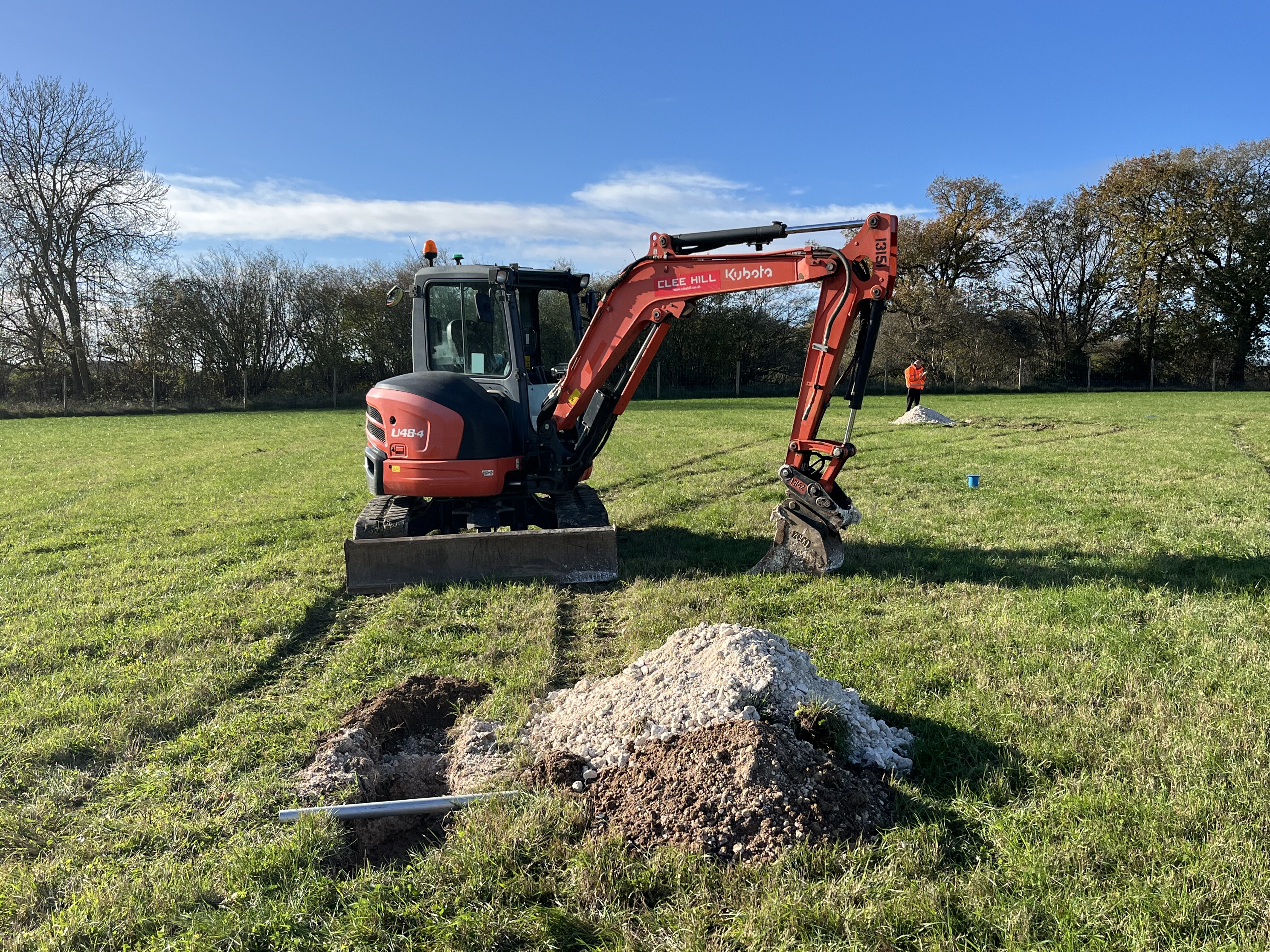
BRE 365 Soakaway Testing: Pitfalls and Better Practice

BRE Digest 365 is the UK’s method for measuring soil infiltration rates and providing the information required to design soakaways for sustainable drainage (SuDS).

The main purpose of carrying out a Soakaway Assessment is to provide the number that underpins design: the infiltration rate. This is used to confirm feasibility and enable drainage engineers to design the correct size of soakaway feature, to ensure they can accept the run off from the proposed development and that they can empty between storms.

But a BRE 365 test is not just “fill a hole and time how long it takes to drain.” When the test is treated like this, you risk undersized systems, flooding complaints, and headaches at handover post completion of the development.

The difference between a robust design and a failure is how you plan, execute, and interpret the testing.

Below, we outline the issues often encountered through poor interpretation of Soakaway testing results and how a geo-environmental consultant can manage them.

Before Testing – Planning with the Ground Model

The risk:

Without a ground model, infiltration testing is often carried out in the wrong places, at the wrong depth, or in soils that were never suitable in the first place. This wastes money and can create unnecessary health and safety risks.

Typical issues include:

  • Testing in impermeable soils such as clay, where infiltration will never be viable.
  • Ignoring made ground or contaminated strata, risking mobilisation of pollutants.
  • Placing tests at the wrong depth relative to the proposed soakaway.
  • Overlooking site regrading or cut-and-fill profiles, meaning results don’t match final ground levels.

How consultants manage it:

A strong desk-based assessment comes first. A geo-environmental consultant reviews geological maps, groundwater data, historic land use, and site investigation records. This allows unsuitable sites to be ruled out early and test locations to be planned properly.

In some cases, the evidence is clear enough to demonstrate infiltration is not feasible. However, some Local Authorities still require BRE 365 infiltration tests to be completed in order to prove infeasibility before they will accept alternative drainage strategies. Where this is the case, the consultant’s role is to:

  • Carry out the minimum testing necessary to satisfy the requirement.
  • Record and present results clearly in the context of the wider ground model.
  • Provide a strong, defensible argument that infiltration is not viable, allowing the project team to move forward with attenuation, discharge, or other drainage methods.

During Testing – Interpreting Results Correctly

The Risk:

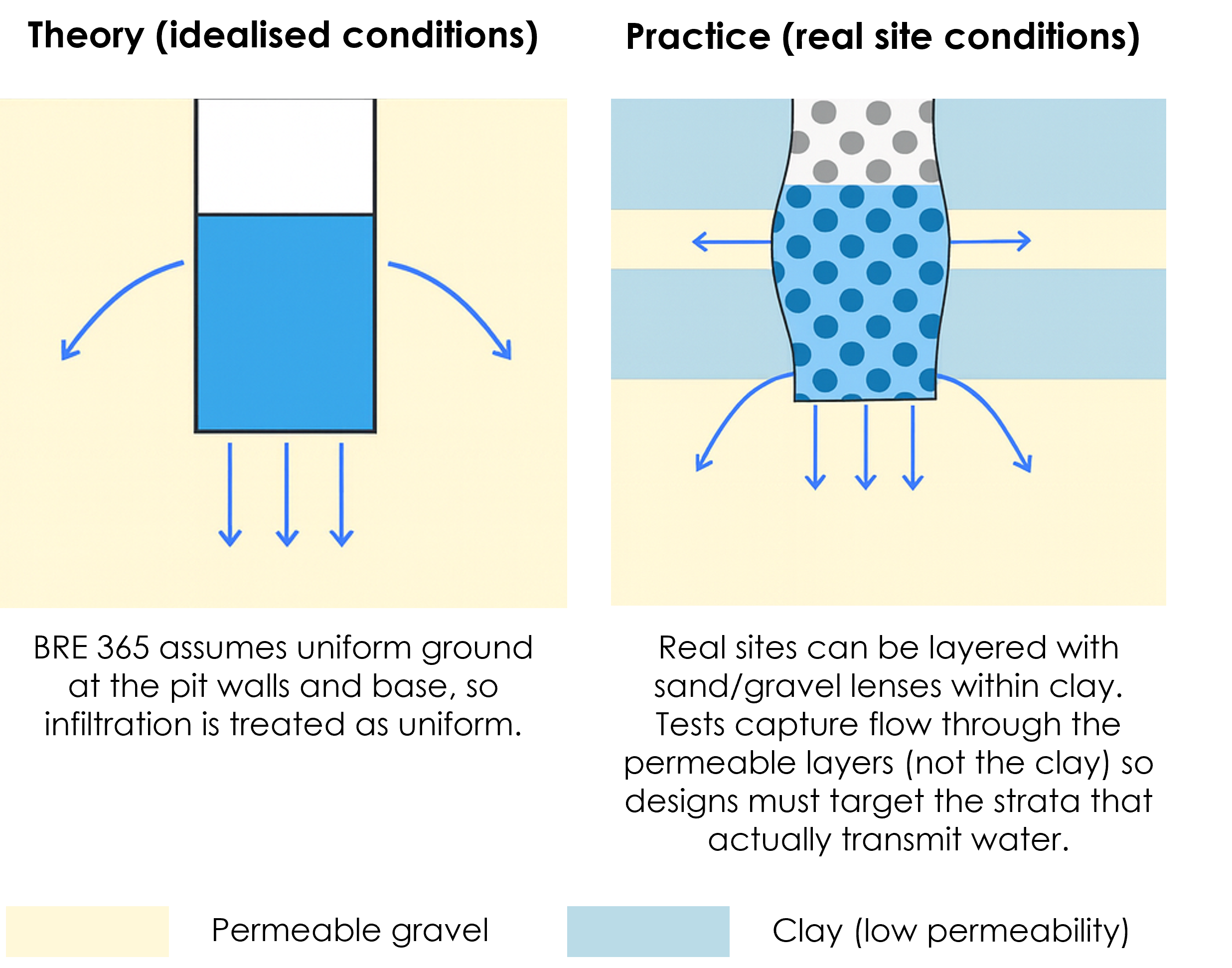
BRE 365 analysis assumes that water infiltrates evenly through the base and sidewalls of the test pit. In reality, infiltration is almost always controlled by the most permeable strata that the water can access. This is critical in interbedded (layered) ground, where deposits change between different strata over a shallow depth, for example where clay overlies sand.

Typical scenarios include:

  • Sand or gravel between clays:
    A permeable lens or layer at the base of the pit will take most of the water. The surrounding clay walls will contribute almost nothing. If this layer is thin or laterally discontinuous, infiltration performance will be overstated in the long term.
BRE 365 Soakaway Testing
  • Chalk beneath superficial clay:
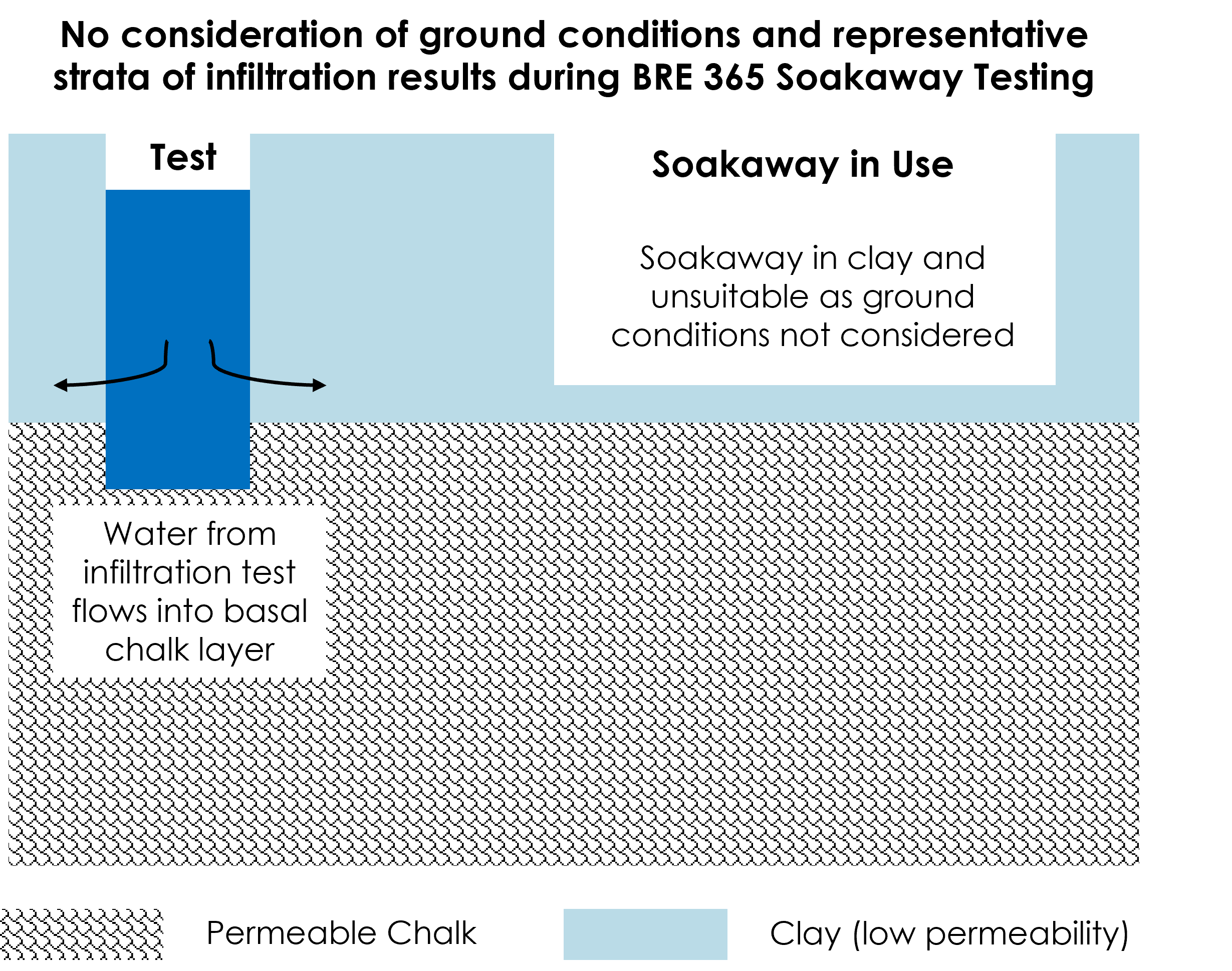
    The clay cap may appear impermeable at the surface, but if the pit intercepts chalk bedrock, rapid infiltration may occur out the base of the pit. Without understanding the depth and continuity of the chalk, designers risk assuming a soakaway will always function, when in fact perched water or seasonal groundwater fluctuations may block the pathway.

Why this matters:

If the ground model isn’t used to interpret results, the design team can be misled in two directions:

  • False positives: Test results may suggest excellent infiltration capacity because water disappears into a localised gravel seam or fissured chalk horizon. But if that layer is thin, discontinuous, or seasonally saturated, the soakaway will fail in service.
  • False negatives: Where only a small portion of the test pit accesses a permeable layer, the calculated infiltration rate may be averaged across the whole pit surface. This underestimates the true capacity of the permeable layer, leading to oversized, overly conservative designs.
  • Inaccurate designs: Perhaps the most serious risk is assuming that the infiltration rate measured in a test applies to the whole soakaway volume, without checking which strata actually control infiltration. Two common scenarios highlight the problem:

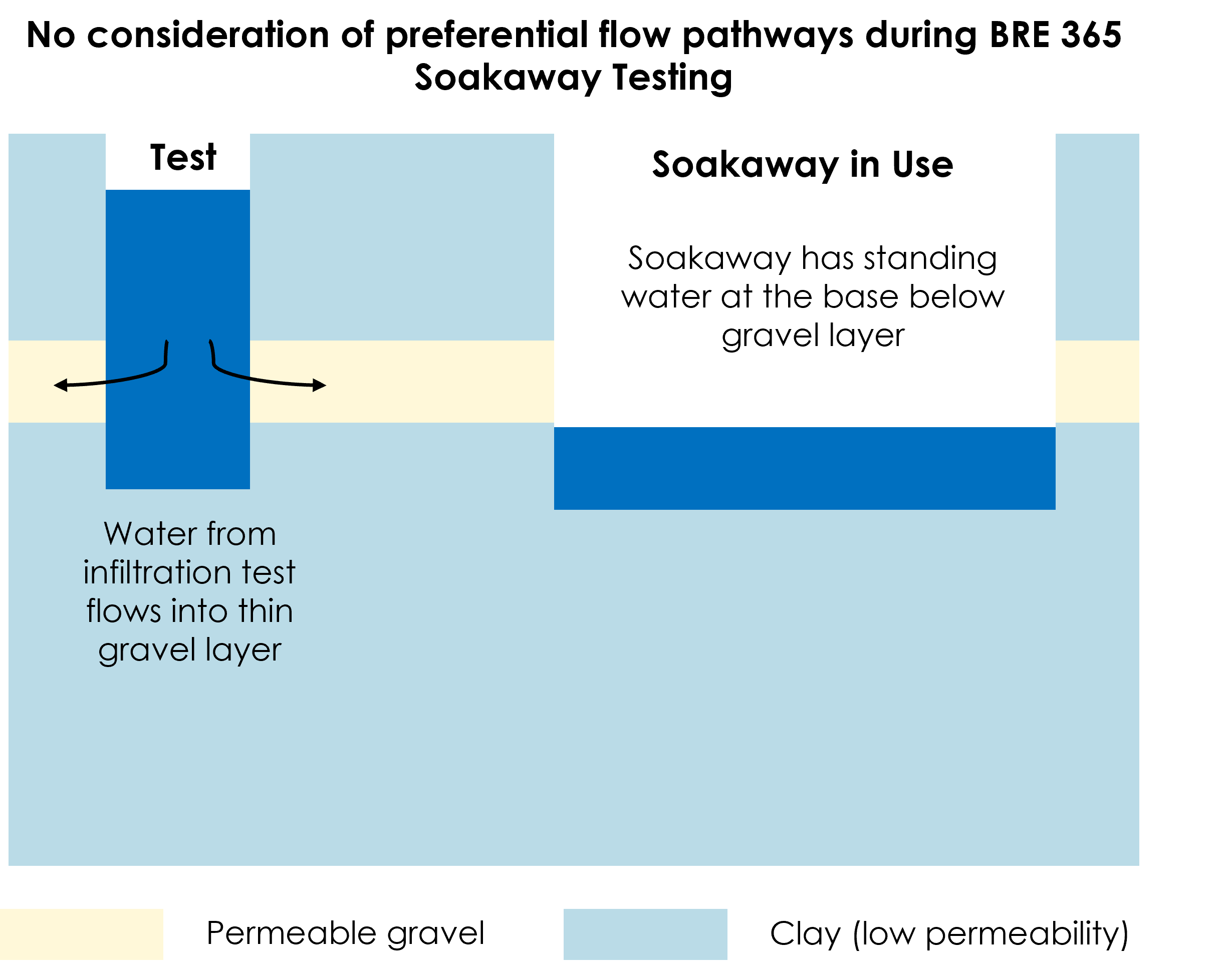
Case 1 – Thin permeable layer above an impermeable base:

During testing, water escapes into a gravel seam within otherwise clayey ground. If this rate is used for design, the constructed soakaway may quickly fill to its clay base, leaving standing water and reducing effective capacity
Case 2 – Permeable basal layer overlain by clay

In some cases, water in a test pit rapidly leaves through a chalk or gravel layer at depth. If the soakaway is then constructed entirely within the overlying clay (because the ground model wasn’t considered), it will not perform as intended.
How consultants manage it:

Qualified geo-environmental professionals log soils to BS 5930/ISO 14688 standards during testing. This ensures infiltration rates are tied to the correct strata. Consultants also apply professional judgement – sense-checking results against published permeability values and amending BRE 365 analysis where layered soils are present.

The Consultant’s Role

BRE 365 testing is not just about filling a hole with water. It is about infiltration assessment which required combining site data, soil logging, professional interpretation, and regulatory knowledge.

By managing the ground model effectively, a geo-environmental consultant can:

  • Avoid unnecessary testing on unsuitable sites.
  • Select appropriate, safer alternatives (such as borehole permeability or ring infiltrometer tests).
  • Ensure infiltration designs are reliable, cost-effective, and compliant.
  • De-risk development by avoiding soakaway failures that lead to flooding or enforcement action.

Ignoring the ground model turns BRE 365 testing into an expensive box-ticking exercise. Embracing it transforms infiltration testing into a powerful tool for delivering SuDS that work in practice.

For developers and designers, the takeaway is clear: involve a geo-environmental consultant early. A well-planned infiltration assessment, grounded in a robust conceptual model, will save cost, avoid failure, and give regulators confidence in your drainage strategy.

If you’re new to infiltration testing or want a refresher on the basics, start with our companion piece: Soakaway Testing: A Developer’s Guide

When a Phase 1 Desk Study identifies potential environmental risks, the next step is a Phase 2 Site Investigation, also called an intrusive investigation. This critical stage gathers real-world data to confirm or rule out contamination, protecting your project from unforeseen costs, planning delays, or environmental liabilities.

In this guide, we break down:

  • How Phase 2 builds on Phase 1.
  • The different investigation techniques (and when to use each).
  • Typical timescales.
  • How laboratory testing refines the site’s risk profile.
  • What to expect at the end of a Phase 2 investigation.

How Phase 2 Builds on Phase 1

While a Phase 1 is based on desk research and a site walkover, a Phase 2 collects physical evidence through soil, groundwater, and ground gas sampling.


In short:

Phase 1 = Identify Potential Risks.

Phase 2 = Confirm or Dismiss Risks with Hard Data.

The findings from Phase 2 enable:

  • Quantitative Risk Assessments (QRA) based on actual contamination levels.
  • Decisions about whether remediation is necessary.
  • Planning condition discharge if no unacceptable risks are found.

Phase 2 Site Investigation Methods

Different methods are used depending on the site, the anticipated risks, and the required depth of investigation:

  • Trial Pits:
    • Best For: Shallow contamination, made ground assessment, visual soil profiling, locating foundations.
    • Typical Depths: Up to 4 metres.
    • Equipment: Mechanical excavator or hand-dug.
    Borehole (Window Sampling):
    • Best For: Shallow contamination, installation of ground gas and groundwater wells, restricted access sites, cost-effective sampling.
    • Typical Depths: Generally 5–6 metres, but can extend up to 10 metres depending on ground conditions.
    • Equipment: Window sampling rig (tracked or towed).
  • Boreholes (Cable Percussive):
    • Best For: Deeper soils, groundwater sampling, ground gas monitoring, and collecting geotechnical data.
    • Typical Depths: Up to 30 metres or more.
    • Equipment: Cable percussion drilling rig.
  • Boreholes (Rotary Drilling):
    • Best For: Hard ground, bedrock investigations, and installation of deep groundwater wells.
    • Typical Depths: Up to 100 metres or more.
    • Equipment: Rotary drilling rig (open hole, cored, or augered).
  • Method
    Best For
    Typical Depths
    Equipment
    Trial Pits
    Shallow contamination, made ground, visual soil profiling, locating foundations
    Up to 4m
    Mechanical excavator or hand-dug
    Borehole (Window Sampling)
    Shallow contamination, installation of ground gas and groundwater wells, restricted access sites, cost-effective sampling
    Generally 5-6m but can go up to 10m depending on ground conditions
    Window sampling rig (tracked or towed)
    Boreholes (Cable Percussive)
    Deeper soil investigation (or dense gravels), groundwater sampling, ground gas monitoring, geotechnical data, restricted access if cut down.
    Up to 30m+
    Cable percussion drilling rig
    Boreholes (Rotary)
    Competent geology (hard), bedrock investigations, proper recovery of chalk, deep groundwater wells
    Up to 100m+
    Rotary drilling rig (open hole, cored, or augered)
    Tip: On smaller development sites, a combination of trial pits and window sampling often provides excellent coverage at a cost-effective price.

    Types of Laboratory Testing During Phase 2

    After sampling, the materials collected are sent for laboratory analysis to determine contamination levels:

    • Soil Testing:
      • Heavy metals (e.g., lead, arsenic)
      • Hydrocarbons (TPH, PAHs)
      • Asbestos in soil
      • Emerging contaminants (e.g., PFAS)

    • Groundwater Testing:
      • Soluble contaminants (e.g., hydrocarbons, BTEX, solvents)
      • Metals in solution
      • PFAS detection

    • Ground Gas Monitoring:
      • Methane, carbon dioxide, oxygen concentrations
      • Flow rates (for CS classification)

    The results are then compared against appropriate assessment criteria to determine whether remediation is needed.

    What Happens After Phase 2 Sampling?

    1. Data Analysis and Quantitative Risk Assessment (QRA):

    Risk to human health, controlled waters, or property assessed.

    2. Conceptual Site Model Update:

    Confirmed pollutant linkages mapped and risk-ranked.

    3. Decision Point:

    No significant risks: Reporting and planning condition discharge.

    Significant risks: Recommend remediation (Phase 3).

    Phase 1 vs Phase 2 - Quick Comparison Table

    Feature
    Phase 1 (Desk Study)
    Phase 2 (Site Investigation)
    Based On
    Desk research and site Walkover
    Sampling and laboratory testing
    Purpose
    Identify potential contamination risks and determine if further investigation is requried
    Confirm or rule out presence of contamination
    Outcome
    Initial risk screening, inform scope of Phase 2 (if requried)
    Quantitative risk assessment
    Typical Timescales
    10 Days
    4-6 Weeks

    FAQs About Phase 2 Site Investigations

    What happens if contamination is found in a Phase 2?

    More Than

    If contaminants exceed safe levels, a Remediation Strategy (Phase 3) will be needed to outline how risks will be managed.

    Can a Site Investigations rule out the need for remediation?

    More Than

    Yes. Many sites require no further action after a properly scoped Phase 2 investigation.

    Is ground gas monitoring always required during a Phase 2?

    More Than

    Not always. It depends on the site's history, geology, and desk study findings.

    Why a Clear Phase 2 Strategy Matters

    A well-designed Phase 2 Site Investigation provides confidence, clarity, and control.


    It ensures you're fully informed about site risks, avoids unnecessary remediation, and moves your project efficiently through planning.

    At Clear Environmental, we tailor Phase 2 investigations to your site. No over-scoping, no hidden costs, just clear advice.

    If your Phase 2 results raise concerns, understanding how to move forward with proportional, commercially realistic remediation is crucial.

    To learn what happens next from Phase 2 to Remediation Click Here.

    Related Services

    What is a Phase 1 Desk Study (Preliminary Risk Assessment)?

    A Phase 1 Desk Study (Preliminary Risk Assessment) is an initial environmental assessment that researches a site’s history and conditions to identify potential contamination risks.

    Whether you're planning to develop land, submit a planning application, or purchase a brownfield site, understanding environmental risks early is essential.


    A Phase 1 Desk Study (also called a Preliminary Risk Assessment, Contaminated Land Assessment or Land Quality Report) is the first critical step in managing those risks efficiently, helping avoid costly surprises later in your project.

    This guide explains exactly what a Phase 1 involves, why it’s required, and what you can expect from the process.

    What is a Phase 1 Desk Study?

    A Phase 1 Desk Study is a preliminary environmental assessment that evaluates the potential for land contamination based on historical and current land uses.

    It is called a “desk study” because it mainly relies on reviewing existing records and data sources, alongside a site visit.


    It does not involve any intrusive ground investigation, that's reserved for Phase 2 Site Investigation if risks are identified.

    In simple terms:

    A Phase 1 identifies if there’s a potential problem — before you commit to site purchase, design, or construction.

    Why is a Phase 1 Desk Study Needed?

    A Contaminated Land Report is often required to:

    • Support planning applications (especially brownfield or previously developed sites).
    • Satisfy lender due diligence for property transactions.
    • Manage liability and avoid unexpected abnormal costs.
    • Confirm if further investigations (Phase 2) are needed.

    Without a Phase 1, local authorities, insurers, and funders may refuse to progress development or financing.

    Key Components of a Phase 1 Desk Study

    A thorough Phase 1 typically includes:

    Component
    What it Involves
    Desk Based Research
    Reviewing historical maps, regulatory databases, geological records, flood risks, landfill sites, industrial use, and environmental permits.
    Site Walkover Survey
    Visiting the site to observe current land use, conditions, structures, evidence of contamination (e.g., oil staining, storage tanks).
    Conceptual Site Model (CSM)
    Developing a model showing potential contamination sources, pathways (e.g., groundwater movement), and receptors (humans, buildings, water).
    Risk Assessment
    Identifying pollutant linkages and advising whether a Phase 2 investigation is necessary.

    What Does a Phase 1 Report Contain?

    A typical Phase 1 Desk Study Report will include:

    • Executive Summary (key findings and recommendations).
    • Site location and description.
    • Historical land use review (maps and aerial photography).
    • Environmental setting (geology, hydrology, groundwater).
    • Regulatory database review (permits, enforcement notices, pollution incidents).
    • Walkover survey findings (including annotated site photos).
    • Preliminary Conceptual Site Model (CSM).
    • Risk assessment and clear conclusions.
    • Next steps, if further investigation is needed.

    At Clear Environmental, our Phase 1 reports are concise, commercially-focused, and designed to satisfy planning authorities and lenders without unnecessary complexity.

    How Long Does a Phase 1 Desk Study Take?

    Most Phase 1 assessments can be completed within 10 Days.


    We also offer fast-track services if you’re working to tight planning or transaction deadlines.

    Phase 1 Desk Study vs. Environmental Search: What's the Difference?

    Feature
    Phase 1 Desk Study
    Environmental Search Report
    Who prepares it?
    Environmental Consultant
    Data Aggregator (automated process)
    Site Walkover?
    Yes
    No
    Conceptual Site Model?
    Yes
    No
    Risk Assessment?
    Yes, taylored to your site, proposal and project
    No, generic alerts only
    Planning Authority Acceptance?
    Yes
    No

    Key point: An Environmental Search is not a substitute for a Phase 1 — it’s simply a basic desktop screening.

    Why Clear Environmental for Your Phase 1?

    A Phase 1 Desk Study isn’t just a box-ticking exercise, it’s your first opportunity to manage risks, reduce abnormal development costs, and protect your investment.

    At Clear Environmental, we combine technical expertise with commercial insight to deliver Phase 1 Reports that meet planning, legal, and financial requirements quickly and clearly.

    Related Services

    FAQs About Phase 1 Environmental Desk Studies

    When should I commission a Phase 1 Environmental Report?

    More Than

    Ideally before site acquisition or at the earliest planning stage, so risks and costs are identified early.

    Will a Phase 1 Desk Study always recommend a Phase 2 Site Investigation?

    More Than

    No — many sites with clean histories and no risk linkages can be signed off at Phase 1.

    Who needs a Phase 1 Environmental Desk Study?

    More Than

    Developers, property investors, planners, architects, solicitors, and lenders commonly require Phase 1 studies.

    Will the council accept my Phase 1 report for planning?

    More Than

    Yes — provided it follows UK guidance (such as EA Land Contamination Risk Management (LCRM)) and is prepared by qualified specialists.

    What happens if my Phase 1 shows contamination risks?

    More Than

    We’ll outline the recommended Phase 2 site investigation scope and cost early, so you remain in control.

    FAQs About Contaminated Land Assessments

    What is a contaminated land assessment?

    More Than

    A contaminated land assessment identifies whether land poses environmental or health risks, helping manage liabilities before development or purchase.

    What is the difference between Phase 1 and Phase 2?

    More Than

    Phase 1 is a desktop and site walkover study identifies potential risks. Phase 2 collects soil, water, and gas samples to confirm actual contamination.

    How long does a Phase 1 Environmental Report and Phase 2 Site Investigation take?

    More Than

    A Phase 1 takes 10 days. A Phase 2 takes 4-6 weeks depending on complexity.

    What happens if contamination is found during a Site Investigation?

    More Than

    A remediation strategy is developed to remove or manage the risks to acceptable levels.

    Do I always need a Phase 2 investigation?

    More Than

    Not always — if Phase 1 finds no significant risks, Phase 2 may not be necessary.

    FAQs About Contaminated Land Assessments

    What’s a Ground Gas and Vapour Strategy (GGVS)?

    More Than

    A GGVS is a targeted investigation to assess the presence and risk of gases such as methane, carbon dioxide, and vapours. It typically involves installing monitoring wells, conducting several monitoring visits, and using standards like CIRIA C665 and BS8485 to determine whether protection is needed.

    Do I need gas monitoring for a small extension in RBKC?

    More Than

    Not necessarily. If the Phase 1 Ground Gas Risk Assessment confirms no credible risk — for example, if the site is underlain by intact London Clay with no Made Ground — monitoring may not be needed. In low-risk situations, RBKC may accept the installation of basic gas protection measures with a verification statement instead.

    How long does a ground gas investigation take from start to finish?

    More Than

    The monitoring phase typically requires 3 - 6 visits spread over a few weeks, depending on site complexity and weather pressure conditions. Including report preparation, the whole process can take around 6 - 12 weeks.

    Can I reuse historical ground gas data for planning?

    More Than

    Yes — provided the data is recent, reliable, and representative of current conditions. Clear Environmental reviews historic site investigation records early to help reduce costs and avoid unnecessary repeat monitoring.

    What happens if gas risks are confirmed?

    More Than

    If gas concentrations exceed safe thresholds, you’ll need to install mitigation measures such as membranes, venting layers, or structural barriers. Clear Environmental will design a practical, proportionate solution and prepare the necessary Remediation and Verification reports.

    What should be included in the Ground Gas Verification Report?

    More Than

    The Verification Report must include photographic evidence, product specifications, a signed statement of installation quality, and confirmation that gas protection was installed in accordance with RBKC expectations. For some projects, additional tracer gas testing may be required.

    Category
    Insights
    Written by
    Blog and articles

    Latest insights and trends