

Introduction
National Policy in England requires that all developments consider how surface water is managed on-site, with a strong preference for Sustainable Urban Drainage Systems (SuDS). Many local planning authorities now require developers to demonstrate that SuDS have been fully considered in line with the SuDS hierarchy. That starts with infiltration.
In order to know if SuDS are feasible for your development, you first need to know the infiltration rate. This information must be passed to a drainage engineer to inform the drainage design. Without it, you risk project delays, the need to redesign your drainage, or refusal at planning.
What Is a Soakaway Test and Why Does It Matter?
A soakaway test (also called a percolation or infiltration test) determines how quickly water drains into the ground. If the soil drains well enough, you can use a soakaway or other infiltration feature to manage surface water on-site to meet planning policy requirements.
If SuDS are feasible, you can avoid costly drainage connections, reduce flood risk, help ease pressure on public sewers, and increase your chance of planning approval.
What Is BRE 365?
BRE Digest 365 is the guidance in the UK for testing infiltration rates. It sets out how to carry out a soakaway test properly, and how to size infiltration systems based on the results. Planners, engineers and Building Control all recognise this method, so following it avoids delays and questions later on.
Following BRE 365 ensures your drainage strategy aligns with national planning policy and industry standards.
When Should You Carry Out a Soakaway Test?
As early as possible – ideally before finalising your drainage design or submitting a planning application. It helps:
- Confirm if infiltration drainage is feasible;
- Determine how big your soakaway needs to be; and
- Prevent redesigns or rejections.
Crucially, planners and drainage authorities now expect clear evidence to justify when infiltration drainage is not being used, just as much as they need infiltration data to design an appropriate scheme when it is feasible. Early testing provides both the evidence and confidence needed to support your proposed development.
How a BRE 365 Soakaway Test Works
Here’s how the process looks in practice:
1. Dig a Trial Pit
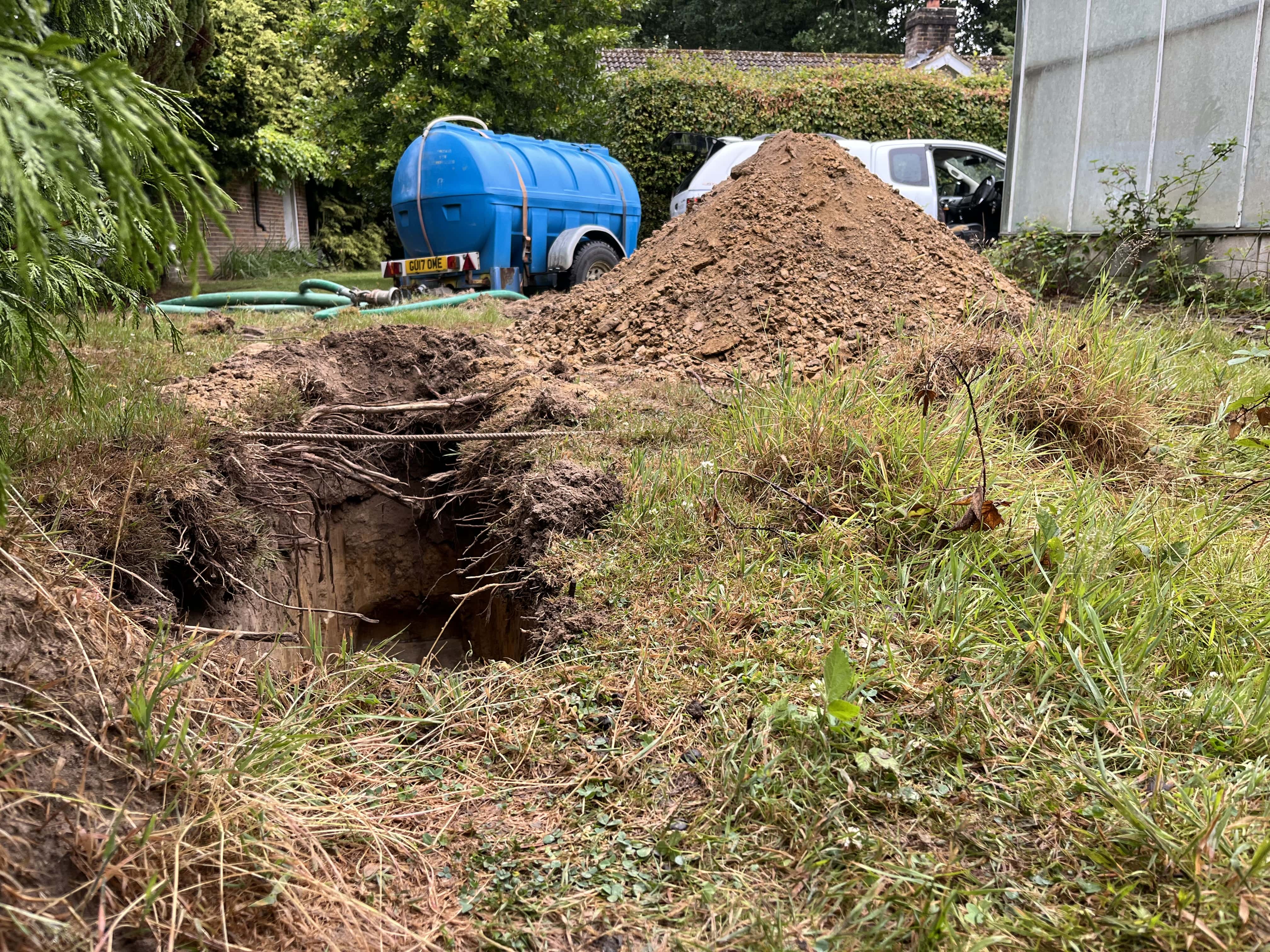
We excavate a square pit, generally 0.6m wide x 1.0m long and 1.5 -2.5m deep (or to proposed soakaway depth), at the planned soakaway location. This ensures the soil tested is representative of the drainage point.
2. Prepare and Fill the Pit
We clear any loose soil and fill the pit with clean water to simulate a storm. The idea is to see how quickly the water drains away into the soil.
3. Measure the Drop
We monitor how fast the water level drops over time.
4. Repeat and Record
The test is done at least three times to get reliable results and to simulate saturated conditions. Calculations are then undertaken to determine the infiltration rate (how quickly the water dropped) based on the time taken for the water level to drop between 75% and 25% of the depth of the water.
5. Report and Advise
We issue a clear summary of the results, including whether infiltration is likely to be viable and what to do next.
Common Mistakes to Avoid
- Not Testing the correct location, especially on sites with variable geology.
- Assuming infiltration will work (or won’t) without testing. Planners increasingly expect site-specific evidence to justify your drainage approach.
- Only testing one location on larger or sloping sites
We make sure the test is done right, in the right conditions, with clear advice.
What Happens If the Test Fails?
If infiltration isn’t suitable, there are other options like attenuation tanks, or discharging to a sewer (with consent). But knowing early lets you plan and cost appropriately.
How Clear Environmental Can Help
We carry out BRE 365 soakaway tests quickly and cost-effectively across the UK.
What you get:
- Fully compliant testing and reporting.
- Fast turnaround for planning applications.
- Straightforward understandable advice.
Following completion of soakaway testing, results should be passed to a suitably qualified civil or drainage engineer to inform the detailed surface water drainage design in line with SuDS principles.
Need a soakaway test for planning? Learn what BRE 365 testing involves, when to do it, and how it helps meet SuDS policy. Avoid costly delays with fast, jargon-free guidance from Clear Environmental.
Our services cover due diligence, contaminated land, ground conditions and drainage.
Explore our services →Related guidance
Get a quote for your site.
Send us the address and what you’re planning. A senior consultant will reply with a quote and the right first step, usually within one working day.